Michael A. Heroux

Papers and Videos


My papers are archived on Zenodo with permanent DOIs. Each has a short pitch video on YouTube and a quiz you can take to check what you took away.

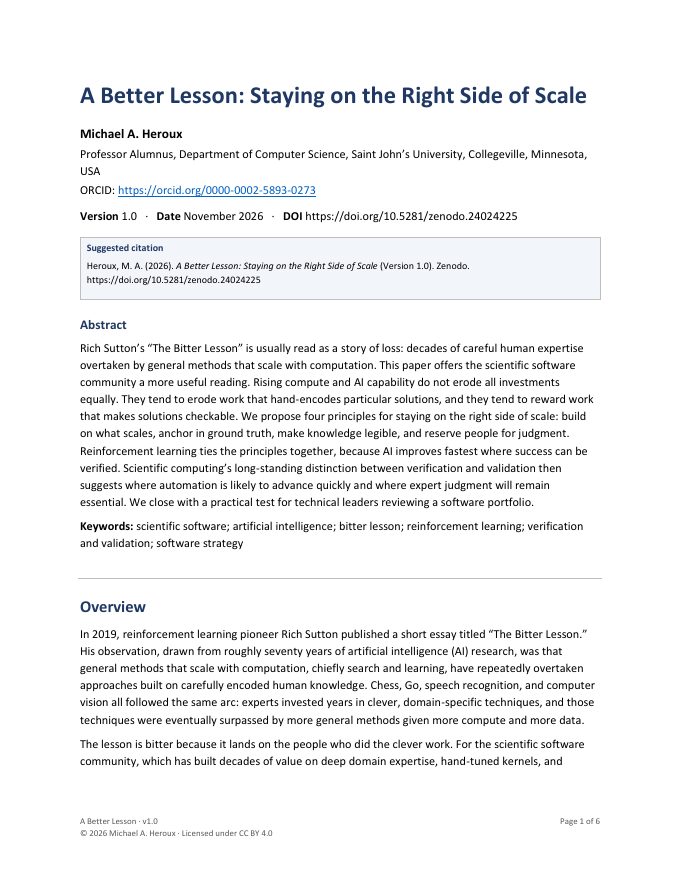
A Better Lesson: Staying on the Right Side of Scale

Michael A. Heroux · November 2026 · Version 1.0

Rising compute and AI capability do not erode all investments equally. They tend to erode work that hand-encodes particular solutions, and they tend to reward work that makes solutions checkable. We propose four principles for staying on the right side of scale: build on what scales, anchor in ground truth, make knowledge legible, and reserve people for judgment.
Take the Challenge: quiz yourself on this paper →

DOI: 10.5281/zenodo.24024225

QPUs Are Not GPUs: Why Quantum Processors Need Constant Classical Control

Michael A. Heroux · November 2026 · Version 1.0

Many in the HPC community expect quantum processing units (QPUs) to fit into future systems the way GPUs do: as accelerators that receive work from a host and return results. This paper argues that the analogy misses something essential. Qubits are fragile, and useful quantum computation depends on quantum error correction, in which classical decoders must interpret syndrome measurements and feed corrections back to the device continuously, often within microseconds. It closes with implications for system architects and facility planners: integrating quantum computing into HPC is as much a classical systems problem as a quantum one.

Take the Challenge: quiz yourself on this paper →

DOI: 10.5281/zenodo.24028100

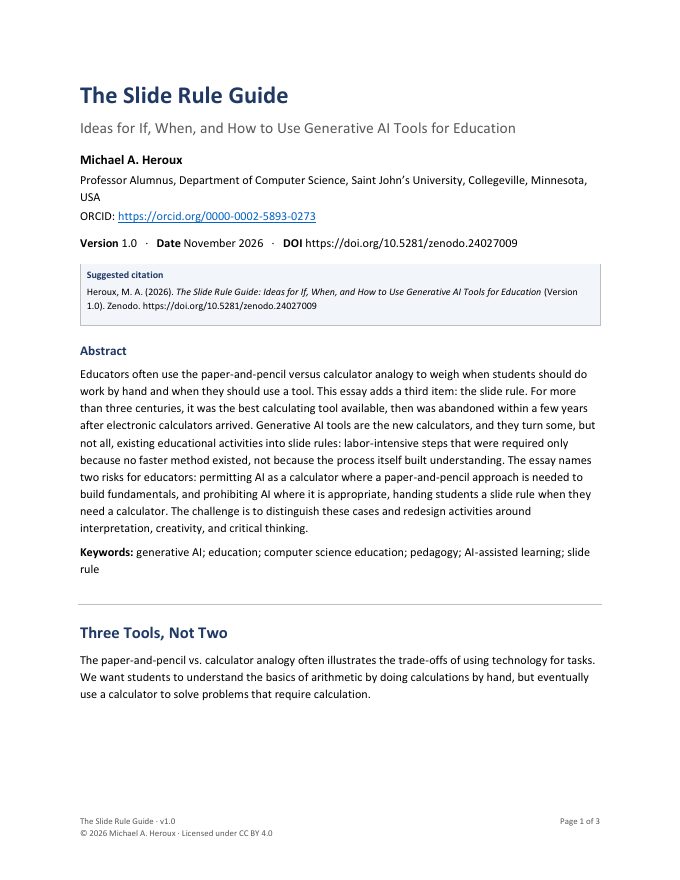
The Slide Rule Guide: Ideas for If, When, and How to Use Generative AI Tools for Education

Michael A. Heroux · November 2026 · Version 1.0

Generative AI tools are the new calculators, and they turn some, but not all, existing educational activities into slide rules: labor-intensive steps that were required only because no faster method existed, not because the process itself built understanding. The essay names two risks for educators: permitting AI as a calculator where a paper-and-pencil approach is needed to build fundamentals, and prohibiting AI where it is appropriate, handing students a slide rule when they need a calculator. The challenge is to distinguish these cases and redesign activities around interpretation, creativity, and critical thinking.

Take the Challenge: quiz yourself on this paper →

DOI: 10.5281/zenodo.24027009

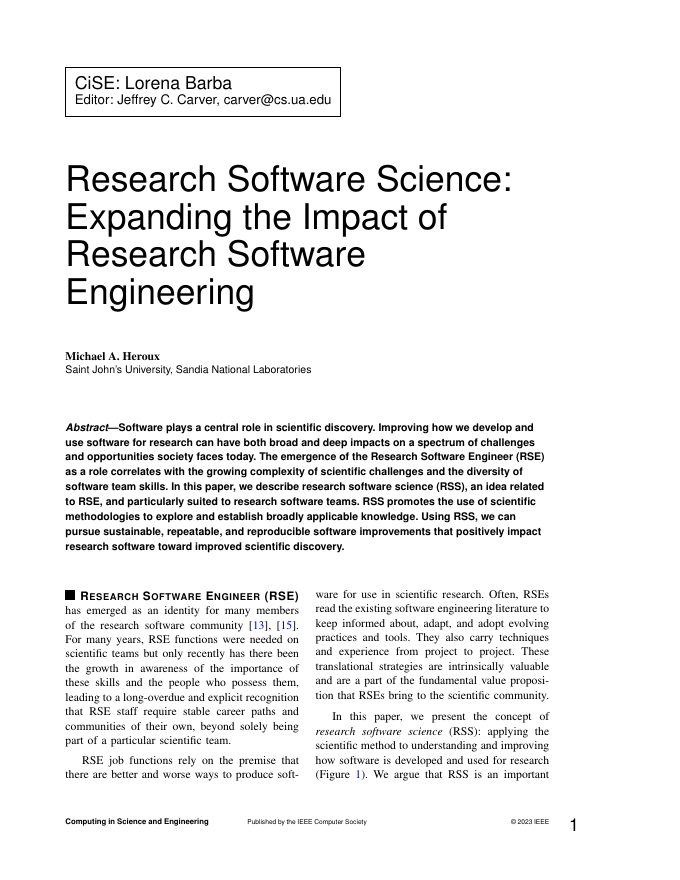
First page of Research Software Science: Expanding the Impact of Research Software Engineering Read paper ↗

First page as published in Computing in Science & Engineering. Copyright remains with the publisher; not under this site's licenses.

Video thumbnail for Research Software Science: Expanding the Impact of Research Software Engineering Watch video ↗

Research Software Science: Expanding the Impact of Research Software Engineering

Michael A. Heroux · November 2022 · Computing in Science & Engineering 24(6): 22–27

Software plays a central role in scientific discovery. Improving how we develop and use software for research can have both broad and deep impacts on a spectrum of challenges and opportunities society faces today. The emergence of the Research Software Engineer (RSE) as a role correlates with the growing complexity of scientific challenges and the diversity of software team skills. In this paper, we describe research software science (RSS), an idea related to RSE, and particularly suited to research software teams. RSS promotes the use of scientific methodologies to explore and establish broadly applicable knowledge. Using RSS, we can pursue sustainable, repeatable, and reproducible software improvements that positively impact research software toward improved scientific discovery.

Take the Challenge: quiz yourself on this paper →

Video DOI: 10.5281/zenodo.24115973